
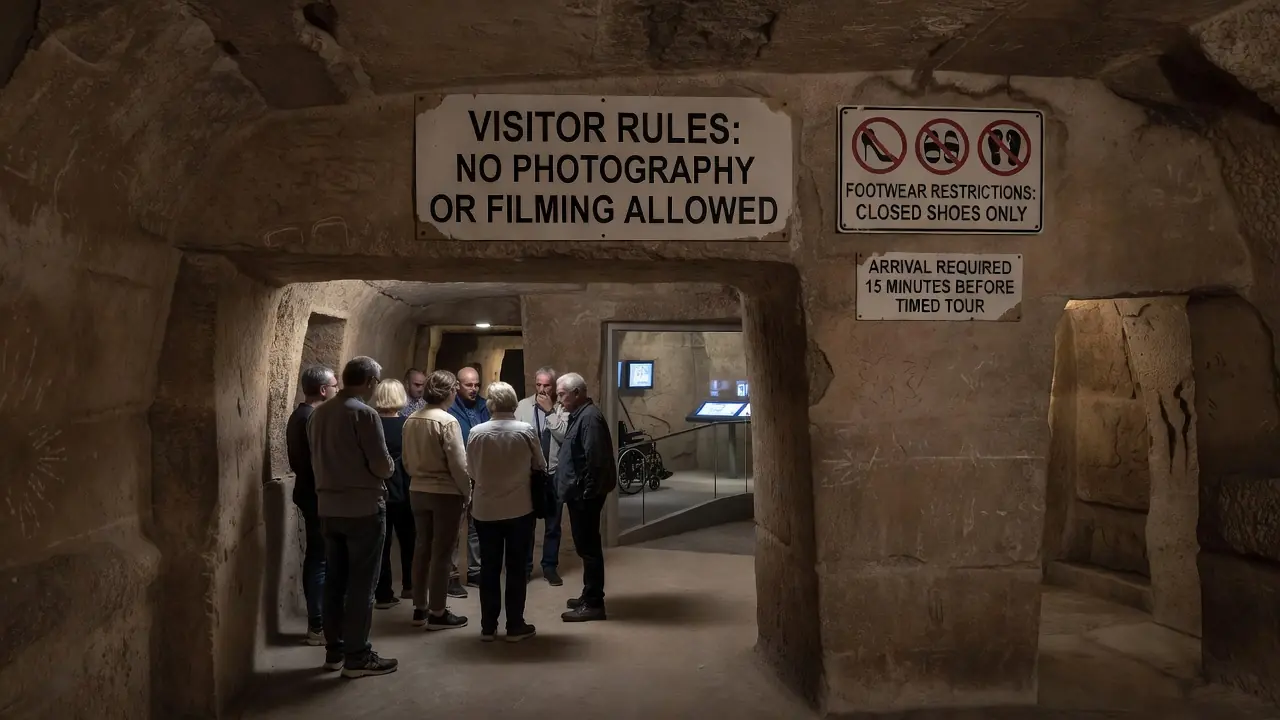
Access to one of the Mediterranean's most fragile archaeological sites now comes with a strict set of conditions designed to protect both the monument and the people who visit it. The Ħal Saflieni Hypogeum, entered from Triq iċ-Ċimiterju, operates under rules that prioritise conservation over convenience, and understanding them matters more than usual given how limited entry is.
Why the Restrictions Exist
This is not a typical heritage attraction with open-door access. The Hypogeum is an underground complex carved thousands of years ago, and its microclimate is sensitive to humidity, light and foot traffic. That is why photography and filming are banned inside, and why footwear rules are enforced without exception: no high heels, sandals or flip-flops. These are not bureaucratic quirks but practical measures to prevent damage to surfaces that cannot be restored once eroded. Visitors are also expected to arrive 15 minutes before their scheduled tour, since late arrivals risk disrupting a controlled, timed-entry system built around small group sizes.
Accessibility Has Real Limits
The site offers a wheelchair-accessible audio-visual show and a small display area, which gives visitors with mobility restrictions a meaningful way to engage with the history on offer. However, the archaeological chambers themselves are not wheelchair accessible, a limitation rooted in the physical structure of the original excavation rather than any lack of effort to accommodate visitors. Similarly, children under six are not admitted, a safety-driven policy linked to the confined, dimly lit underground environment rather than an arbitrary age cutoff.
Booking Pressure and the Last-Minute Ticket System
Demand consistently outstrips supply at this site, and the ticketing system reflects that reality. Advance booking is strongly recommended because space is limited by conservation needs, not business strategy. For travellers who did not plan ahead, last-minute tickets exist but follow a rigid structure:
- Last-minute tickets are sold only one day before the visit, on a first-come, first-served basis.
- Before 12 PM, they are available exclusively at Fort St Elmo and the Gozo Museum of Archaeology.
- After 12 PM, sales shift to the National Museum of Archaeology and the Hypogeum itself.
- These tickets cost 50 Euro, reflecting both scarcity and the premium placed on protecting visitor numbers.
This layered system is a practical response to a structural problem: a world-heritage site with capacity constraints that cannot be solved simply by adding more time slots. It also means travellers hoping to rely on spontaneity face real risk of missing out entirely.
What Ticket Holders Gain Beyond Entry
Admission tickets carry added value that visitors sometimes overlook. Ticket holders receive 15% off the official Hypogeum guidebook at the onsite shop, a modest but useful incentive for those wanting deeper context on the site's history. More notably, presenting a Hypogeum ticket at the Ħal Tarxien Prehistoric Complex entrance secures a 50% discount on admission there, though this applies only to tickets purchased at the door, not pre-booked online. For visitors planning a fuller day of prehistoric sites, this pairing rewards spontaneity in one direction while still requiring discipline in the other.
Taken together, these policies describe a heritage site balancing public access against long-term preservation. The rules are strict, but they are consistent with international best practice for managing irreplaceable archaeological environments under heavy visitor interest.