
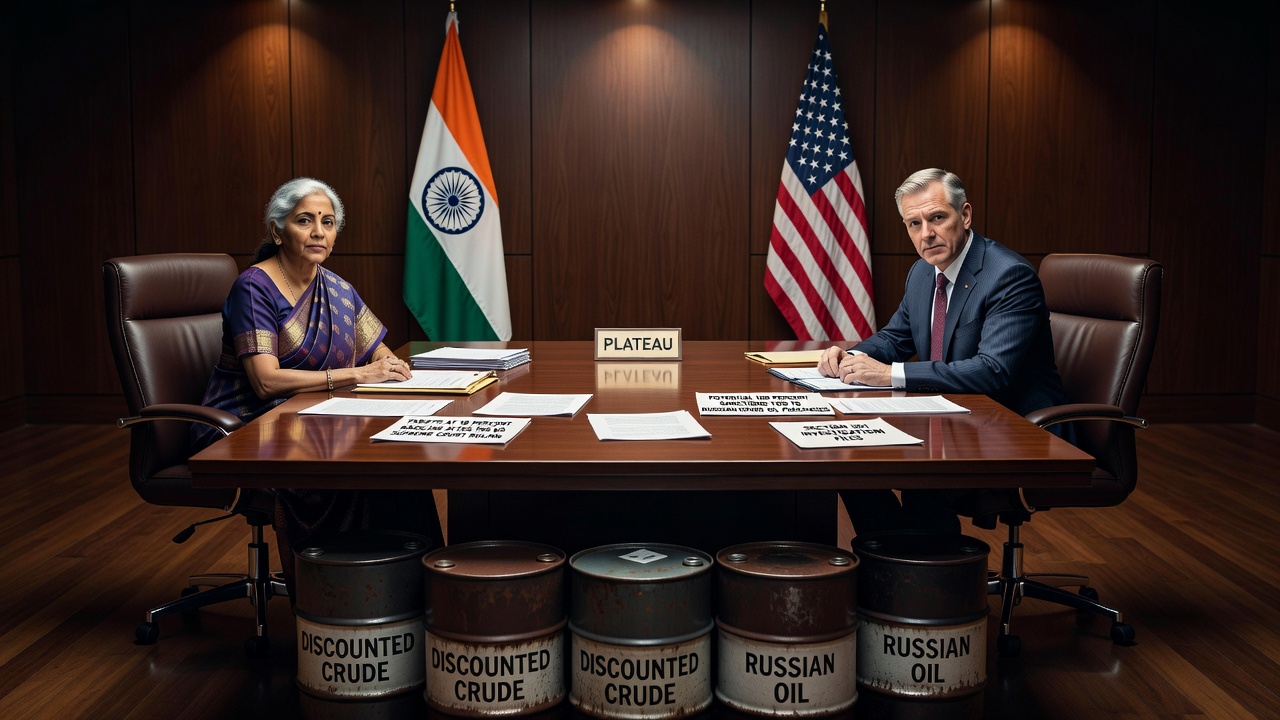
Negotiations between New Delhi and Washington on a long-promised bilateral trade agreement have hit another wall. Finance Minister Nirmala Sitharaman described the talks as having reached a "plateau," while US Trade Representative Jamieson Greer said a deal is not "imminent." The impasse leaves two of the world's largest economies without a settled trade framework at a moment when tariff exposure for Indian exporters remains uncertain.
A Framework Without a Finish Line
The two countries had made visible progress earlier this year. A February framework agreement lowered punitive tariffs on most Indian goods to 18% from 50%, a rate imposed last August after an earlier round of negotiations broke down. A subsequent US Supreme Court ruling struck down the president's use of emergency powers to impose sweeping global tariffs, resetting the baseline rate to 10%. That legal shift removed one source of pressure but did not produce the comprehensive deal both sides have been pursuing for months.
Russian Oil and an Unfinished Investigation
Two unresolved issues are doing most of the damage to momentum. First, a new US law opens the door to tariffs as high as 100% on Indian goods tied to New Delhi's continued purchases of Russian crude oil, purchases that have not meaningfully declined. Washington argues this oil trade helps fund Russia's war effort; India maintains that energy sourcing decisions reflect the practical needs of a population exceeding 1.4 billion people, and that discounted Russian crude became especially relevant after the 2022 invasion of Ukraine reshaped global energy markets.
Second, Washington has yet to conclude a Section 301 investigation examining whether excess industrial capacity in several countries, India among them, is undercutting American industry. Until that probe wraps up, Indian negotiators cannot know what final tariff structure they are negotiating against, which complicates any effort to lock in commitments.
What's at Stake for Exporters and Markets
The United States remains India's largest export destination, and the numbers so far look resilient: goods exports rose to $42.79 billion in the April-August period, up from $40.39 billion a year earlier, with India running a trade surplus of close to $34 billion with the US in fiscal year 2025/26. India points out that major export categories, including generic pharmaceuticals and smartphones, currently sit outside the 10% tariff. But analysts caution that without a finalized agreement, India faces exposure to steeper tariffs once the Section 301 probe concludes or if sanctions tied to Russian oil purchases are enforced, even allowing for the possibility of negotiated waivers.
A fresh tariff increase would carry consequences beyond trade ledgers. It could unsettle business sentiment, pressure the Indian rupee, which is already trading near record lows, and complicate supply-chain planning for exporters who had priced in the lower, post-February rate.
Political Friction Compounding Economic Talks
- India is resisting market-opening commitments on dairy, poultry, rice, wheat and other farm products, sectors considered politically sensitive domestically.
- New Delhi wants clarity on final US tariff rates before offering further concessions.
- Diplomatic strains, including a US military strike near Oman that killed three Indian seafarers and India's public rejection of claims that Washington brokered a ceasefire with Pakistan, have added friction beyond pure trade economics.
Diplomatic contact continues despite the stalemate. US Secretary of State Marco Rubio is expected in India later this month, and Prime Minister Narendra Modi and President Trump, who spoke by phone on September 30, are expected to speak again before Modi's anticipated December visit to the United States for a G20 leaders' meeting. Whether those conversations translate into a finalized agreement, or simply another extension of the current holding pattern, remains an open question.