
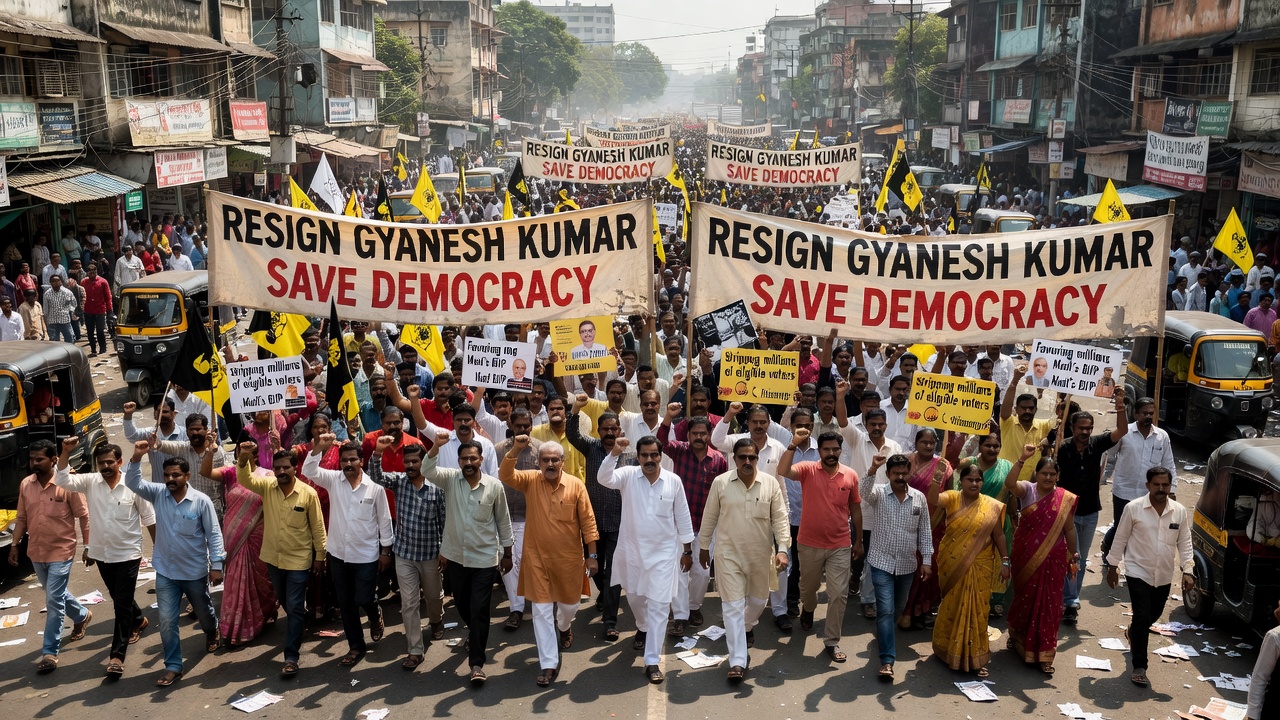
Three consecutive days of street demonstrations have put India's electoral authority under rare public pressure. Thousands gathered in Mumbai on Sunday and in New Delhi for a third straight day, demanding that Election Commission of India chief Gyanesh Kumar resign over voter-roll revisions that critics say have stripped millions of names from electoral lists ahead of future polls.
What Triggered the Unrest
The protests, which began Friday, center on a process meant to clean up India's voter registers by removing duplicate, deceased or otherwise ineligible entries. The Election Commission describes this as routine housekeeping necessary to preserve the integrity of the electoral roll. Opposition figures, including Raj Thackeray and Uddhav Thackeray, who led Sunday's Mumbai march, argue the revisions have disproportionately removed eligible voters in ways that favor Prime Minister Narendra Modi's Bharatiya Janata Party. Both the ECI and the BJP have rejected these claims.
The dispute sits at the heart of a tension found in democracies worldwide: the mechanics of voter-list maintenance, usually a technical and unglamorous function of government, can become politically explosive when one side suspects the process is being used to tilt outcomes rather than simply tidy records.
Policing the Protests
New Delhi police have moved to limit the demonstrations, detaining dozens of protesters as they arrived and bussing them away, according to Reuters. Some detainees were released within hours, but authorities have also opened cases against others for violating restrictions on mass gatherings in the capital's central districts. This pattern, visible over Friday and Saturday and repeated into Sunday, illustrates how quickly a dispute over administrative procedure can escalate into a broader confrontation over the right to assemble and criticize state institutions.
An Election Commission on the Defensive
Facing sustained criticism, the ECI issued an instruction on Friday directing officials to register eligible voters who had been inadvertently dropped from the rolls, an acknowledgment that errors may have occurred even as the agency maintains the overall exercise is sound. Gyanesh Kumar himself has not publicly addressed calls for his resignation or commented directly on the protests.
The commission's credibility matters beyond this single controversy. Electoral bodies function on the presumption of neutrality, and any perception that voter-roll management is being wielded for partisan advantage threatens the legitimacy of outcomes regardless of which party eventually benefits. That is precisely the argument Raj Thackeray made to the Mumbai crowd, framing the dispute as a question of whether voters or the commission should decide who governs.
What Comes Next
The protests show no sign of winding down. An alliance of opposition parties has announced plans for a march to the election commission's office on Tuesday under the banner of "saving democracy," while the youth-driven Cockroach Janta Party has called for a larger rally in New Delhi on October 10. Organizers describe the moment as a turning point for civic mobilization in India, with social media posts from CJP leader Abhijeet Dipke urging broader national solidarity.
How the government and the commission respond in the coming days, whether through further concessions on the voter-roll process, continued policing of demonstrations, or public statements from Kumar himself, will likely determine whether this remains a contained dispute or grows into a wider confrontation over electoral governance ahead of future votes.