
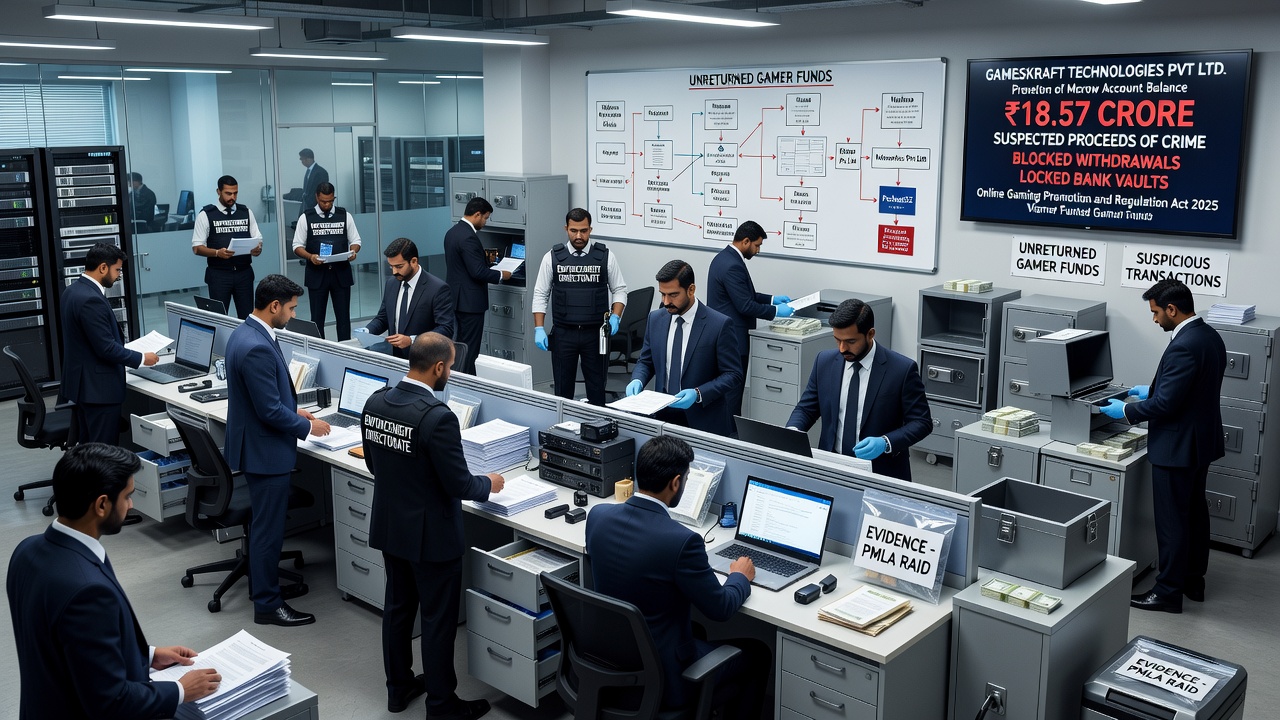
The Enforcement Directorate expanded one of its largest online gaming investigations this week, conducting searches across Delhi-NCR, Bengaluru and other locations tied to an alleged ₹1,000 crore money laundering case linked to online gaming and betting operations. The searches, led by the agency's Bengaluru Zonal Office, targeted Gameskraft Technologies Pvt Ltd, its directors and several associated individuals. The action underscores how aggressively Indian authorities are now scrutinizing the financial plumbing behind real-money gaming platforms.
Officials reportedly seized documents, digital records and electronic devices during the operation, material that will likely form the backbone of the case as it moves through the Prevention of Money Laundering Act framework. This is not the agency's first encounter with Gameskraft; a related but distinct probe was carried out last year. The renewed scrutiny arrives at a moment when regulators, users and even casual players researching something as simple as a chicken road game no deposit bonus are being reminded that the online gaming sector operates under far more legal complexity than the interface suggests. What looks like a straightforward digital entertainment product often sits atop layered corporate structures, escrow arrangements and payment flows that regulators are now examining closely. chicken road game no deposit bonus
The current case traces back to multiple FIRs filed with Bengaluru police, later absorbed into the ED's mandate. A separate but connected investigation, conducted between November 18 and 22 last year, focused on Nirdesa Networks Pvt Ltd and its platform Pocket52, again alongside Gameskraft entities. Complainants alleged manipulated game outcomes, player collusion, opaque algorithms and blocked withdrawals - allegations that, if substantiated, point to systemic failures in platform integrity rather than isolated user disputes.
What the Escrow Freeze Reveals About Platform Accountability
A central element of the investigation involves escrow accounts meant to safeguard user funds. According to the ED, more than ₹30 crore remained unreturned to gamers despite restrictions under the Online Gaming Promotion and Regulation Act, 2025. The agency has since frozen eight escrow accounts holding roughly ₹18.57 crore, treating the funds as suspected proceeds of crime. Escrow systems exist precisely to separate operator funds from user deposits, creating a buffer against exactly this kind of dispute. When that separation fails or is allegedly circumvented, it raises deeper questions about how rigorously platforms are audited before they are permitted to hold public money at all.
Why This Case Matters Beyond One Company
Real-money gaming in India sits at an uneasy intersection of technology, finance and law, with state-level restrictions, central legislation and enforcement agencies often applying different lenses to the same platforms. Cases like this one signal that regulators are no longer treating user complaints about withdrawal delays or algorithmic fairness as customer-service issues alone; they are being read as potential indicators of financial crime. For operators, that shift raises the compliance bar considerably, particularly around transparency in game mechanics and the handling of customer funds. For users, it is a reminder that the ease of signing up and depositing on a gaming app says nothing about the strength of oversight behind it. Money laundering investigations of this scale tend to move slowly, and no findings of guilt have been established at this stage. But the scope of the searches, spanning multiple cities and multiple corporate entities, suggests the ED views this as more than a routine inquiry into one platform's practices.