
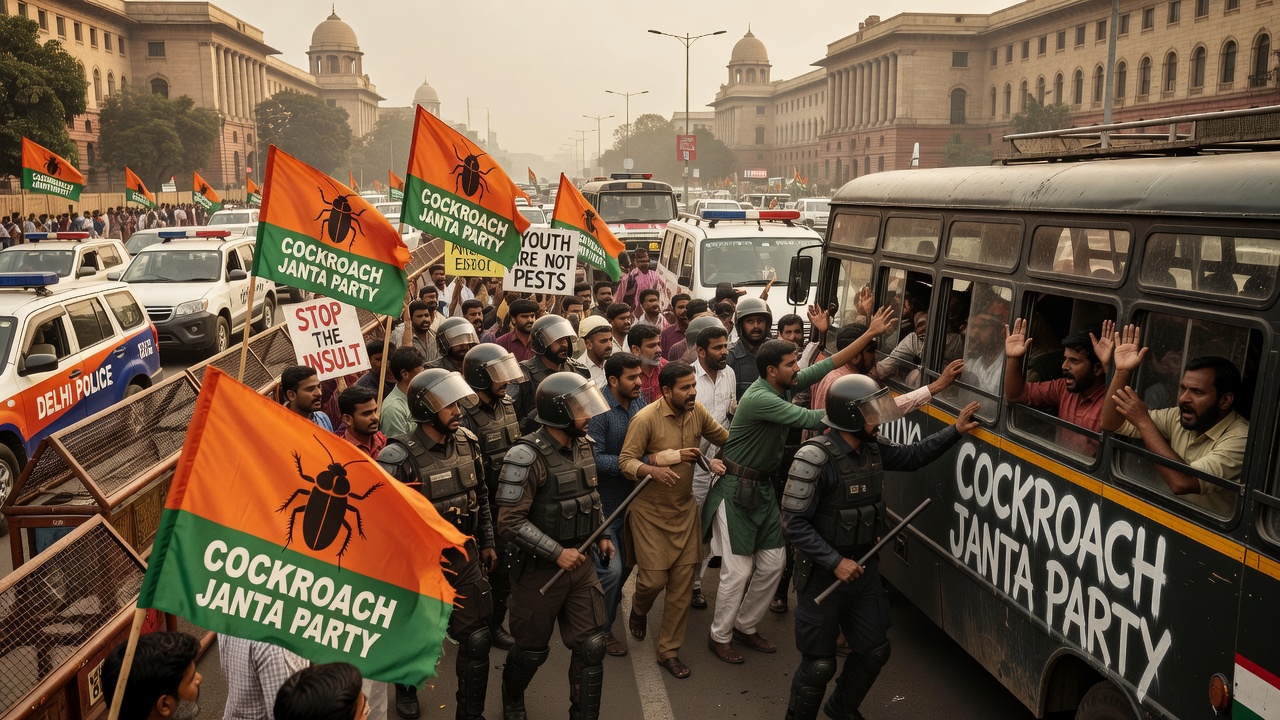
Security forces in Delhi detained the founder of the Cockroach Janta Party, Abhijeet Dipke, along with other leaders of the movement, shortly after they landed in the capital to lead an anti-government demonstration. Video circulated by the party on social media showed protesters banging on the windows of a police bus as officers moved them away from the planned rally site. The demonstration had been refused official permission, yet organisers said they intended to proceed regardless, prompting a large deployment of police and barricades across central Delhi.
Origins of a protest movement
The Cockroach Janta Party emerged in May, following remarks by India's Chief Justice that compared some unemployed young people to cockroaches. What might have remained a passing comment instead became a rallying point. A political movement took shape around the insult, adopting it as both name and symbol, turning a dismissive phrase into a banner for grievances over joblessness and government accountability. The episode illustrates how a single remark from a senior public figure can crystallise wider public frustration, especially when it touches on a sensitive issue such as youth unemployment.
A familiar standoff between protest and permission
Delhi has seen this pattern before: an organisation seeks to hold a public demonstration, the police deny permission citing public order concerns, and the group proceeds anyway, testing the limits of enforcement. The scale of the response this time - described as involving tens of thousands of security personnel and road barricades - signals how seriously authorities treated the threat of disruption in the capital. For protest movements, denial of permission is often treated less as a deterrent and more as a provocation, feeding into a narrative of state overreach that can, in turn, generate further public attention and sympathy.
Why these moments matter beyond Delhi
Scenes of detained protesters and barricaded streets tend to spread quickly once video is shared online, shaping public perception far faster than official statements can respond to. The footage of demonstrators striking bus windows is a clear example: a short, visceral clip that conveys frustration more effectively than a press release ever could. This dynamic is now a standard feature of political confrontation, where mobile footage shared directly by the protesting organisation can shape the story before mainstream coverage catches up, placing pressure on authorities to explain their actions in real time.
What comes next
The underlying grievance behind the Cockroach Janta Party's formation - frustration over employment prospects among young people - is unlikely to dissipate simply because a single rally was blocked. Movements born from a moment of public anger often persist precisely because the triggering event, in this case a remark from the country's top judicial office, remains a visible and repeatable symbol. Whether the party sustains momentum will depend less on this one confrontation with police and more on whether it can translate public frustration into a durable political presence.