
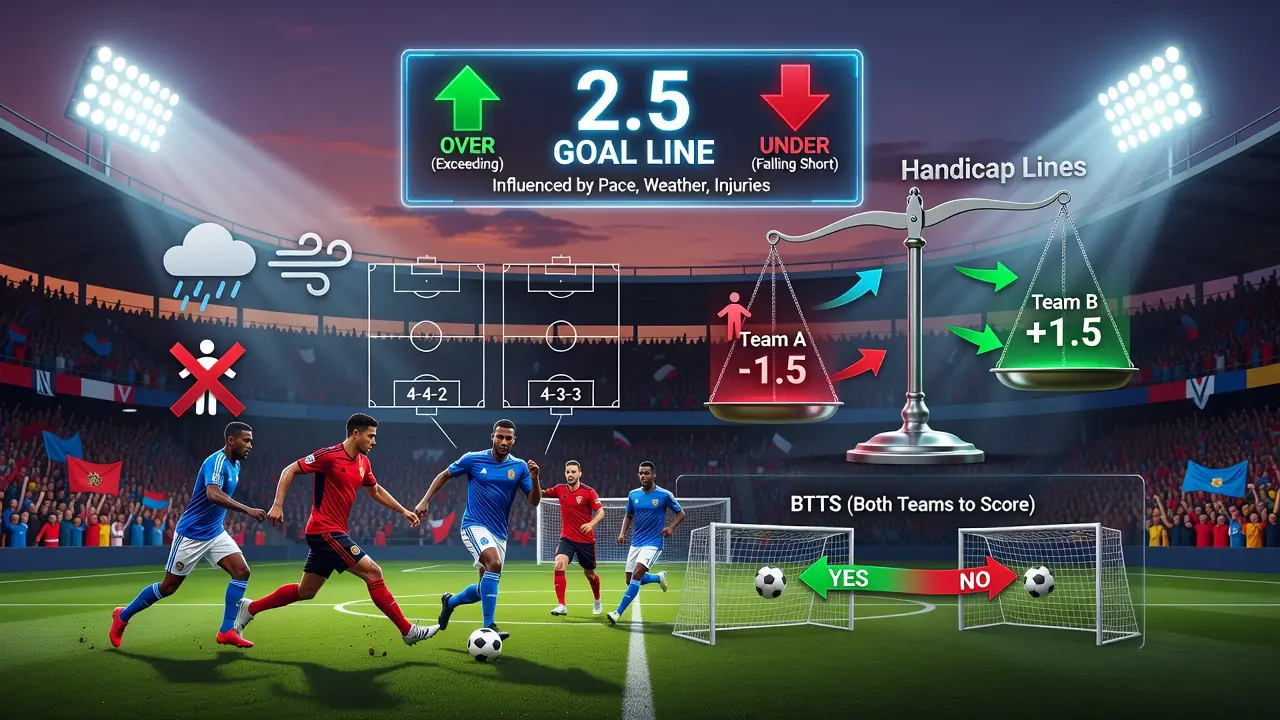
Three betting markets dominate how recreational bettors engage with football and other sports: Over/Under totals, handicap lines, and Both Teams to Score. Each reflects a different way bookmakers try to balance risk and attract wagers on both sides of an outcome. Understanding the mechanics behind these markets matters more than memorizing definitions, because misreading a line is one of the most common reasons casual bettors lose money faster than they expect.
How Over/Under Lines Are Set
Over/Under, also called totals betting, asks bettors to predict whether the combined score in a match will exceed or fall short of a number set by the bookmaker. That number is not arbitrary. It reflects the operator's own models, historical scoring patterns between similar teams, and early betting activity, which the bookmaker adjusts to keep liability balanced on both sides. A line of 2.5 goals exists precisely because it cannot land on a push - the half-goal forces a clear winner, which simplifies settlement but does nothing to improve a bettor's actual odds of winning.
The appeal of totals betting lies in its simplicity: no need to pick a winner, only a scoring threshold. But that simplicity can be misleading. Totals markets are heavily influenced by pace of play, weather, missing players, and tactical setups, factors that shift in the hours before kickoff and that sharper bettors track closely.
Why Handicaps Exist
Handicap betting, sometimes called spread betting, was built to solve a specific problem: mismatched fixtures where one side is overwhelmingly favored. Without a handicap, bookmakers would need to offer extremely short odds on the favorite, which makes the bet unattractive to most bettors. By applying a virtual deficit or advantage - Team A starting at minus-1.5, Team B at plus-1.5 - the market creates two roughly balanced propositions out of a lopsided fixture.
This structure shifts the question from "who wins" to "by how much," which changes the type of analysis required. A bettor assessing a handicap line needs to think about scoring margins, game state, and whether a favorite is likely to ease off once ahead - considerations that a simple win/draw/win bet does not require.
Both Teams to Score and Its Appeal
BTTS strips away the question of the final result entirely and focuses only on whether both sides find the net at least once. Its popularity has grown alongside attacking, high-tempo leagues, where defensive solidity is rarer and open play more common. The market's binary nature - yes or no - makes it easy to understand, but that same simplicity means it rewards close study of defensive records and attacking form on both sides of the fixture, not just one favored team.
- Over/Under rewards analysis of pace, tactics, and weather conditions near kickoff.
- Handicap betting requires judgment on scoring margins, not just match outcomes.
- BTTS depends equally on both teams' attacking and defensive form, not a single favorite.
Platform Choice and Responsible Engagement
None of these markets change the underlying mathematics of betting: the bookmaker's margin is built into every line, regardless of how the odds are presented. Competitive pricing, transparent terms, and regulatory licensing are what separate credible operators from those cutting corners on consumer protection. Bettors should confirm that a platform is licensed in their jurisdiction, offers clear information on deposit and withdrawal processing, and provides accessible tools for setting deposit limits or self-exclusion.
Markets like Over/Under, handicap, and BTTS offer more ways to engage with a match, but variety is not the same as advantage. No combination of markets overcomes the structural edge built into bookmaker pricing. Treating betting as entertainment with a fixed budget, rather than a method of generating income, remains the only sound approach regardless of which market a bettor chooses.