
Blackjack Strategy: How to Calculate Odds and Make Smarter Decisions to Minimize Bust Risk
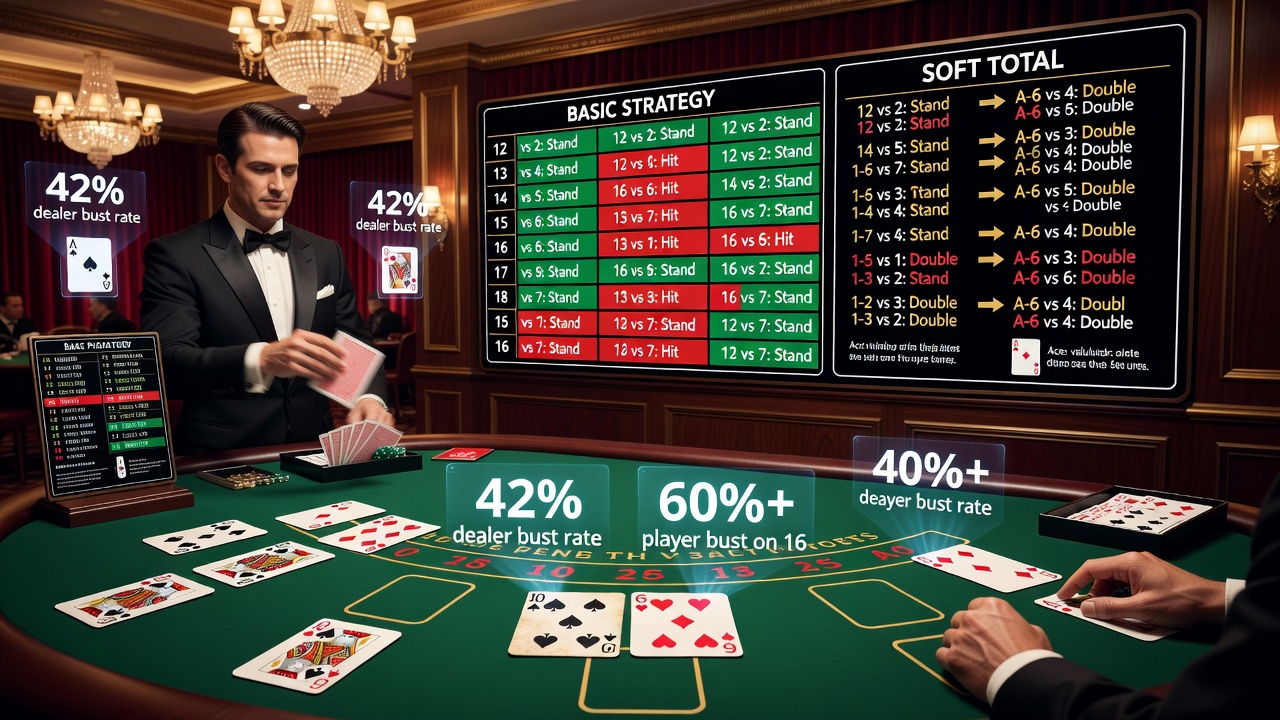
A dealer showing a 6 will bust roughly 42% of the time. A player holding a stiff hand of 16 will bust more than 60% of the time if they draw a card. These two numbers, sitting side by side, explain almost everything wrong with how casual players approach blackjack. They hit when they should hold, and they hold when the math says hit - usually because gut instinct overrides arithmetic at the exact moment arithmetic matters most.
Busting isn't bad luck. It's the predictable outcome of decisions made without reference to probability. Every card removed from the shoe changes the odds for the next one, and skilled players track that shift instinctively. For anyone who wants a deeper breakdown of the mechanics behind this, the guide on how to avoid busting in blackjack lays out the dealer-side probabilities that most players never bother to learn. Understanding those numbers changes how you see every hand at the table, because you stop reacting and start calculating.
This piece breaks down the actual math behind bust risk, shows how basic strategy charts encode decades of probability analysis, and gives concrete methods for tightening your decision-making under pressure. None of it requires card counting or memorizing decks. It requires understanding what the cards in front of you actually mean.
Understanding Bust Risk in Blackjack
Busting happens when a hand's total exceeds 21, and it's the single most common way players lose money at the blackjack table - more common than losing to a dealer's stronger hand. The reason is structural: once you bust, you lose automatically, even if the dealer would have busted too on the very next card.
What Causes a Bust
A bust occurs from drawing a card that pushes your total past 21. This is purely a function of your current hand value and the cards remaining in the shoe. A hand totaling 12 or higher carries bust risk on any hit, and that risk climbs sharply as the total increases. At 16, over two-thirds of remaining cards will break the hand. At 12, roughly a third will.
Why Bust Risk Varies by Hand Total
Every point above 11 narrows your safety margin, because ten-value cards - tens, jacks, queens, kings - make up nearly a third of the deck. A hand at 13 can absorb an 8 but not a 9 or 10. A hand at 16 can only absorb a 5 or lower. This is why the range from 12 to 16, often called the "stiff zone," causes the most trouble and the most inconsistent decision-making among inexperienced players.
The Dealer's Bust Rate as a Reference Point
Dealers follow fixed rules - hit until 17, then stand - which makes their bust probability calculable for every upcard. A dealer showing 2 through 6 busts far more often than one showing 7 through ace. That single fact underlies most of basic strategy: when the dealer's upcard suggests a high bust probability, you play more conservatively and let them take the risk instead of you.
How to Calculate Odds to Avoid Busting
Calculating odds in blackjack doesn't require a statistics degree. It requires knowing a handful of reference numbers and applying them consistently, hand after hand.
Counting Remaining High and Low Cards
A standard deck has four cards of each rank, with ten-value cards representing four ranks worth of density. When you're deciding whether to hit a 15, you're really asking: how many cards in the remaining shoe would bust me? Against a single deck, if no ten-value cards have been played, you're looking at roughly 16 cards out of 51 that would break your hand - call it a 31% bust chance on that single draw, which is manageable compared to a 16 in the same position.
Using Bust Probability Tables
Experienced players rely on published bust probability tables that show your exact risk of breaking a hand based on your total. These tables confirm what intuition often gets wrong: a total of 12 only busts about 31% of the time on a hit, barely more than a coin flip in your favor, while a total of 16 busts nearly two-thirds of the time. Comparing your total against these fixed numbers is the fastest way to calculate odds to avoid busting without doing arithmetic mid-hand.
Factoring in the Dealer's Upcard
Your hand's bust risk means little in isolation. The decision to hit or stand depends on comparing your risk against the dealer's likely outcome. If the dealer shows a 6, their bust probability is high enough that standing on a stiff hand and letting them draw is usually correct, even though your own hand might bust on a hit too. This comparative calculation - your risk versus theirs - is the core of a sound blackjack strategy for minimizing bust risk.
- Dealer upcards 2-6: higher bust probability, favors standing on stiff totals
- Dealer upcards 7-A: lower bust probability, often forces a hit even on stiff totals
- Your total 12-16: highest sensitivity to dealer upcard strength
- Your total 17+: standing is almost always correct regardless of dealer upcard
Blackjack Basic Strategy to Prevent Busts
Basic strategy charts exist precisely because the odds calculations above have already been done, exhaustively, for every possible hand-versus-upcard combination. Following the chart means you're applying correct probability without recalculating it at the table.
Hard Totals and When to Stand
Hard totals - hands without an ace counted as 11 - are where bust discipline matters most. Basic strategy says to stand on hard 17 or higher without exception. Between 12 and 16, the correct play depends entirely on the dealer's upcard, not on how the hand feels. A 16 against a dealer's 10 is a forced hit despite the high bust risk, because standing loses even more often against a strong dealer hand.
Soft Totals and Flexible Play
Soft totals include an ace counted as 11, giving you a built-in safety net since the ace can drop to 1 if you draw a high card. A soft 18 (ace-7) can be hit against a dealer 9, 10, or ace without any bust risk on that next card, making soft hands far more forgiving. This flexibility is part of why basic strategy treats soft and hard totals so differently.
Splitting and Doubling Without Increasing Risk
Doubling down and splitting pairs aren't reckless moves - they're calculated ones based on favorable odds, not on chasing bigger wins. Doubling on a total of 11 makes sense because the probability of drawing a ten-value card to make 21 is high and your bust risk on that single card is zero. Splitting 8s against a weak dealer upcard converts one poor hand into two hands with better individual odds, rather than compounding risk.
Tips to Improve Decision-Making and Avoid Busting
Knowing the math is one thing. Applying it consistently, especially after a losing streak or several rounds of good cards, is where most players fall apart.
Stick to the Chart, Not the Streak
Emotional decision-making is the fastest route to unnecessary busts. A player who has lost three hands in a row often starts hitting stiff totals they should stand on, chasing a recovery that the math doesn't support. Basic strategy doesn't change based on recent results, and neither should your decisions.
Recognize the Stiff-Hand Trap
The 12-to-16 range triggers the most inconsistent play because it feels dangerous either way - hitting risks a bust, standing feels passive. Treat this range as a lookup, not a feeling. Check the dealer's upcard, check your total, apply the chart.
Practice Odds Recognition Away From the Table
Running through hand-versus-upcard scenarios outside of live play - using a chart or basic strategy trainer - builds the automatic recall you need under time pressure. Players who practice this way make fewer hesitation errors, because the correct play becomes reflexive rather than calculated in real time.
Avoid Table-Side Superstitions
Betting patterns, "hot" seats, and reading dealer behavior have no bearing on bust probability. Cards don't remember what happened last hand. Anchoring decisions to superstition instead of the fixed odds undermines every other strategic choice you make.
Common Mistakes That Increase Bust Risk
Even players who know basic strategy in theory often deviate from it under specific conditions. Recognizing these patterns is as valuable as knowing the correct plays themselves.
Hitting Too Conservatively on Soft Hands
Many players treat any total near 18 as automatically safe to stand on, ignoring that a soft 18 against a dealer 9 or 10 is a losing proposition more often than not. Standing pat out of a false sense of security forfeits the flexibility a soft hand provides.
Standing Too Early on Low Totals
Some players stand on 12 or 13 against a strong dealer upcard, mistaking caution for strategy. Against a dealer 10 or ace, a low total requires a hit because the dealer's own bust probability is too low to justify passivity.
Ignoring the Upcard Entirely
Playing your hand in isolation, without weighing the dealer's shown card, is the most common structural error at the table. Every correct decision in blackjack is a function of two variables, not one.
Frequently Asked Questions
Is it ever correct to hit a hard 16?
Yes. Against a dealer upcard of 7 through ace, hitting a hard 16 is correct despite the high bust probability, because standing loses even more frequently against those strong dealer cards. The bust risk is high either way; hitting simply gives you better overall odds.
Does the number of decks in play change bust probability?
Slightly. More decks mean the composition of remaining cards changes more slowly, keeping bust probabilities closer to the theoretical averages found in standard tables. Single or double-deck games can shift bust odds more noticeably as cards are removed from play.
Can card counting help me avoid busting more precisely?
Card counting primarily tracks the ratio of high to low cards remaining, which does inform bust risk on borderline hands like 12 through 16. It's more useful for betting decisions than for basic hit-or-stand choices, which basic strategy already covers accurately for most situations.
Why do basic strategy charts sometimes tell me to hit when it feels risky?
Charts are built on total expected outcomes across thousands of simulated hands, not on any single hand's emotional weight. A play can carry real bust risk and still be statistically correct if the alternative loses more often overall.
Does standing always protect me from losing the hand?
No. Standing eliminates bust risk on that hand, but you still lose if the dealer's final total beats yours. Standing is only correct when the probability of the dealer busting or landing on a lower total outweighs the risk of you busting by hitting.
How much does dealer upcard strength really matter?
It's the single biggest factor in every hit-or-stand decision. A dealer showing 2 through 6 is statistically likely to bust, which should push you toward standing on stiff totals, while a 7 through ace upcard shifts the correct play toward hitting even risky hands.